
The impact of RDSPs on disability assistance programs
How RDSPs interact with disability assistance
See how RDSP withdrawals and contributions interact with provincial disability assistance, with separate checks for each program and province.


This guide separates the federal tax rules from provincial income-assistance rules. It focuses on the treatment of an RDSP balance, contributions, grants and bonds, and payments taken from the plan. Rules can change, and a caseworker or program administrator may need to review the beneficiary's exact situation before a payment is requested.
Start with the federal rule
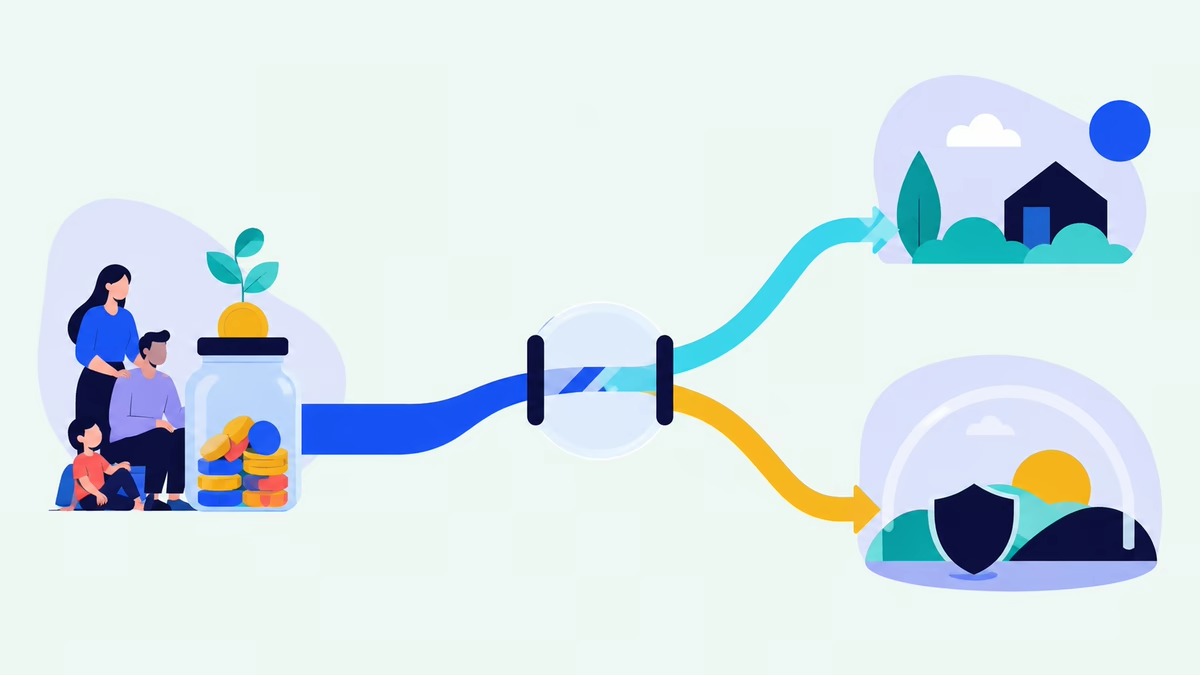
The federal ESDC withdrawal guidance says that opening and contributing to an RDSP will not affect other federal or provincial or territorial benefits. It then names Quebec, New Brunswick and Prince Edward Island as jurisdictions where a withdrawal may affect the amount of provincial benefits. That distinction matters: saving in the plan and taking money out are not the same event.
| RDSP event | Federal guidance | Practical reading |
|---|---|---|
| Open an RDSP | Does not affect other federal or provincial or territorial benefits. | Opening the account is not a withdrawal. |
| Contribute to an RDSP | Does not affect other federal or provincial or territorial benefits. | Confirm the province's reporting process if the program asks for records. |
| Receive a grant or bond | The money goes into the RDSP and is part of the plan's federal rules. | Do not treat it as cash available outside the plan. |
| Withdraw money | May affect provincial benefits in Quebec, New Brunswick or Prince Edward Island. | Check the specific program before taking a payment. |
Know what an RDSP is designed to do
An RDSP is a long-term savings plan for a person approved for the Disability Tax Credit. The federal RDSP overview describes the plan as a way to save for the future and apply for grants and bonds. The DTC guide from REEI explains the related tax-credit starting point, but DTC approval and benefit eligibility remain separate questions.
Contributions are not tax-deductible. The plan can receive Canada Disability Savings Grants and Canada Disability Savings Bonds when the beneficiary meets the applicable rules. The grant and bond amounts are not the same as personal contributions, and the amount available depends on the plan's history and the beneficiary's circumstances. See our guide to the Canada Disability Savings Grant and Bond and bond application guide for the contribution and government-payment mechanics.
| Amount | Federal treatment before withdrawal | Question to ask locally |
|---|---|---|
| Personal contributions | They remain part of the plan and are not taxable when later paid out as original contributions. | Does the program require the contribution to be reported? |
| Canada Disability Savings Grant | It is a government payment into the plan and may form part of a taxable withdrawal. | Does the provincial program exempt a withdrawal? |
| Canada Disability Savings Bond | It is a government payment into the plan and may form part of a taxable withdrawal. | Does the provincial program use a separate income definition? |
| Investment earnings | They grow inside the tax-sheltered plan and are taxable when included in a payment. | How must the payment be reported for the benefit file? |
Understand DAPs, LDAPs and grant repayment
The CRA describes two payment types in its RDSP payment rules. A Disability Assistance Payment, or DAP, is a lump-sum payment if the declaration of trust permits it. A Lifetime Disability Assistance Payment, or LDAP, is a series of periodic payments that, once started, must continue at least yearly until the beneficiary dies or the plan closes.
Before age 60, a withdrawal can trigger repayment of some grant and bond amounts when grants or bonds were paid into the plan during the preceding 10 years. ESDC says the repayment rules do not apply in the same way after age 60, after more than 10 years since the last grant or bond, or where the beneficiary has a reduced life expectancy of five years or less and meets the applicable conditions. The financial institution calculates the amount and confirms whether the payment can proceed.
| Point | What the official guidance says | Why it matters |
|---|---|---|
| Payment type | DAP is a single payment. LDAP is recurring and must continue at least annually once started. | A recurring payment can create a longer commitment than a one-time request. |
| Taxable part | Grants, bonds and investment earnings are taxable. Original contributions are not taxable. | The amount on the T4A may not equal the amount deposited. |
| Holdback and repayment | The issuer must have enough money to repay the assistance holdback amount after the payment, where the rules require it. | A requested amount may be limited or unavailable. |
| Timing | Regular withdrawals must begin by December 31 of the year the beneficiary turns 60. | Age and the plan's grant and bond history affect the payment rules. |
The CRA RC4460 guide says the taxable portion of an RDSP payment is excluded when calculating the GST/HST credit, Canada child benefit, Canada workers benefit, social benefit repayment and refundable medical expense supplement. That is the closed federal exclusion list used in this article. Do not add GIS, OAS or the Canada Disability Benefit to that list. Their treatment requires a separate program-specific check.
Read provincial rules one program at a time
There is no single provincial answer. Ontario, British Columbia, Alberta, New Brunswick, Prince Edward Island and Quebec do not use identical wording or the same process. The table below records what the named government sources say. It does not turn one province's treatment into a rule for another province.
| Jurisdiction and program | What the checked government source says | What to confirm |
|---|---|---|
| Ontario ODSP | Directive 4.10 says RDSPs are fully exempt as income and assets. It includes all withdrawals from an RDSP for any purpose. | Confirm the current directive and keep payment records if the caseworker requests them. |
| British Columbia disability assistance | The BC policy says RDSP assets are exempt and payments are exempt as income and assets. It also says payments can be used for any purpose without affecting eligibility. | Report a payment if the policy procedure requires supporting documentation. |
| Alberta AISH and ADAP | Alberta lists RDSP payments as exempt income. It also says money held in an RDSP is an exempt asset. | Confirm the program file, especially if funds leave the RDSP and are later held elsewhere. |
| New Brunswick social assistance | New Brunswick lists an RDSP as an exempt asset. Its policy says total income generated from an RDSP up to $800 a month is exempt, with possible special amounts for community or health-related support. | Ask how the specific payment will be classified and reported. |
| Prince Edward Island Social Assistance and Assured Income | PEI policy lists RDSP withdrawals as exempt income and the RDSP value as an exempt asset. | Confirm the active program policy and disclose the payment as required. |
| Quebec last-resort financial assistance | ESDC names Quebec as a province where a withdrawal may affect provincial benefits. Quebec's resource page says income and assets are assessed and only applicable exclusions are left out. | Ask the ministère or caseworker how the proposed payment fits the beneficiary's program. |
Ontario's result is unusually clear because the directive states a full exemption for RDSP income and assets, including withdrawals. British Columbia and Alberta also publish broad exemptions in the sources above. New Brunswick and PEI use their own definitions and procedures. Quebec requires particular care because the federal withdrawal page expressly flags possible provincial impact.
The New Brunswick policy is not a national benchmark. Its $800 monthly wording cannot be applied to Quebec, PEI, Ontario, British Columbia or Alberta. The same caution applies in reverse. A broad exemption in one province does not prove that every federal or provincial benefit will ignore a payment.
Keep federal benefits separate from provincial assistance
The five federal items in the CRA exclusion list are GST/HST credit, Canada child benefit, Canada workers benefit, social benefit repayment and refundable medical expense supplement. The list does not mention GIS, OAS or the Canada Disability Benefit. That omission is not permission to assume a payment has no effect. Each program has its own eligibility, income and reporting rules.
| Program or calculation | What this article can say | What it cannot say without a separate rule |
|---|---|---|
| GST/HST credit | CRA says RDSP taxable income is excluded from this calculation. | That every other federal benefit uses the same exclusion. |
| Canada child benefit | CRA says RDSP taxable income is excluded from this calculation. | That a provincial payment will be ignored. |
| GIS and OAS | They are not on the closed list used here. | That an RDSP payment is harmless for either pension program. |
| Canada Disability Benefit | It is not on the closed list used here. | That the benefit administrator will use the same income definition as CRA. |
Use a withdrawal checklist
A withdrawal decision should start with the plan, then move to the benefit file. Ask the financial institution whether the request is a DAP or LDAP, what part will be taxable, whether grants or bonds may be repaid, and whether the plan has enough value to satisfy the assistance holdback rules. Then ask every benefit administrator that could use the payment or the money left after it.
- Write down the beneficiary's province, program name and current benefit file number.
- Ask for the proposed payment type, gross amount, taxable amount and expected payment date.
- Ask the issuer to explain any grant or bond repayment before submitting the request.
- Give the benefit administrator the payment description, not just a bank deposit screenshot.
- Ask whether the program treats the payment as income, an exempt payment, or an asset after receipt.
- Keep the statement, T4A, decision letter and written response together.
For broader planning context, the REEI retirement-planning article can be read alongside this withdrawal-specific guide. It should not replace a written answer from the program that pays the benefit.
Separate a tax return from a benefits file
A tax return and a benefits file can use different definitions. CRA may include a grant, bond or investment earnings in the taxable part of an RDSP payment, while a benefit program may exclude that payment, count it under another rule, or ask for proof of how the funds were used. Do not treat a T4A alone as a benefits decision.
The timing of a payment also matters. A one-time DAP, a recurring LDAP, and money that remains in a bank account after withdrawal can raise different questions. Ask the program whether it assesses the payment when received, the remaining cash in a later month, or both. Keep the written answer with the plan statement.
If the beneficiary has more than one benefit, check them separately. A provincial disability assistance office may apply its own exemption, while a pension or federal income-tested program may use another calculation. The closed CRA list is useful, but it is not a universal answer for every payment program.
Document the answer before taking the payment
Program-specific confirmation is worth getting in writing. A phone answer can be useful, but ask the administrator to identify the policy or directive used and to state whether the conclusion applies to this beneficiary's program. If the answer is unclear, pause the request and ask the financial institution whether the payment can be changed or cancelled before processing.
The central distinction is simple: an RDSP balance is not the same as money withdrawn from the plan. Federal rules protect the opening and funding of the plan, but the named provincial exceptions show why a withdrawal cannot be treated as universally neutral. Ontario's Directive 4.10 provides a full exemption for ODSP. Other jurisdictions need their own confirmation.
Discover our latest articles about RDSP:

























.avif)
.avif)


