
How to access government grants and bonds for your RDSP
What are the RDSP grant and bond?
Canada Disability Savings Grant and Bond explained: 2026 income thresholds, matching rates, the ten-year carry-forward, and how to apply.

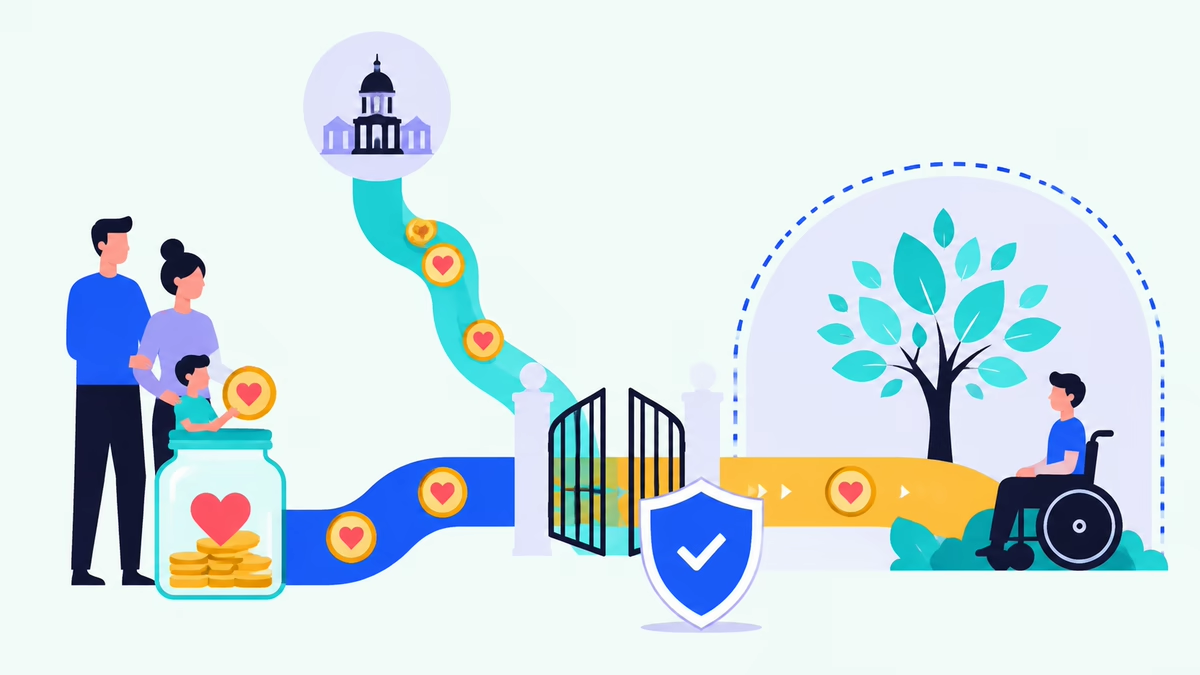
The Canada Disability Savings Grant and the Canada Disability Savings Bond are the two federal payments that separate a Registered Disability Savings Plan from an ordinary savings account. One matches what you put in. The other is paid with no contribution at all. Both are paid by Employment and Social Development Canada into a plan that already exists, which is why the order of operations decides how much you end up with.
Most of the money that gets lost is lost the same way. Entitlements build up for ten years, then fall off the back of that window one year at a time. Someone who was approved for the Disability Tax Credit in 2014 and opens a plan in 2026 has already watched several thousand dollars expire. Nothing about that is recoverable later.
The figures below are the amounts Employment and Social Development Canada publishes for the 2026 calendar year. They are calculated from the family income reported on the 2024 tax return, because the government always looks two years back. Income thresholds are indexed to inflation and shift slightly every year, so check the current-year figure before you plan a contribution.
What are the RDSP grant and bond?
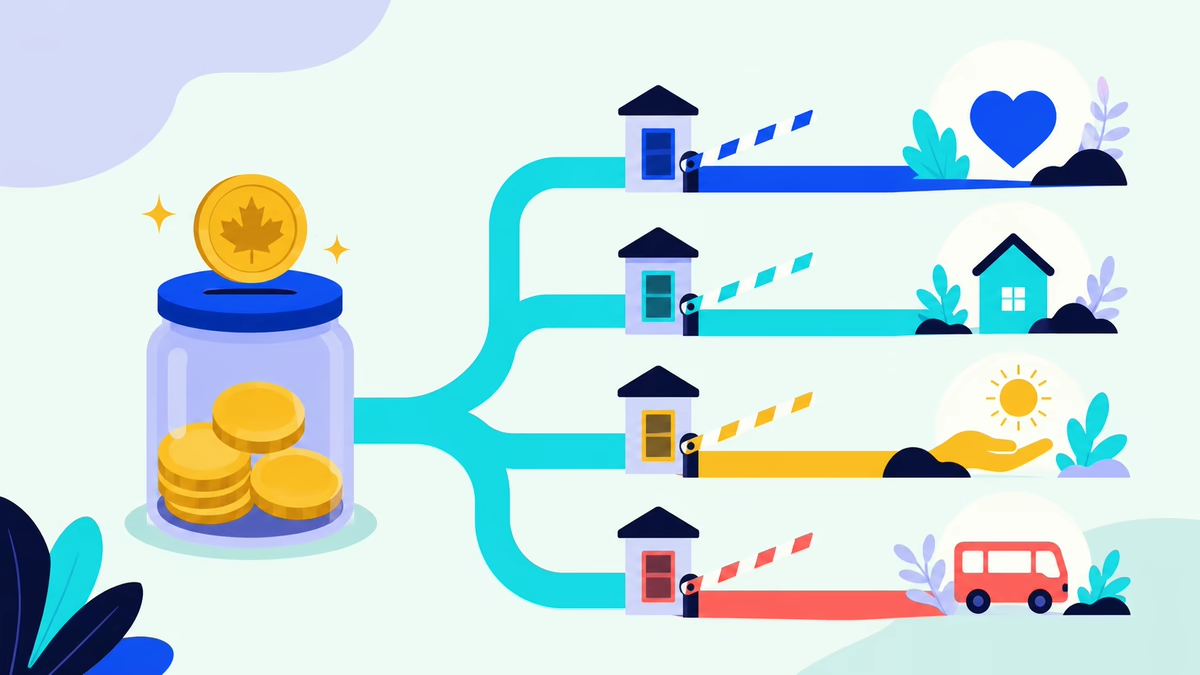
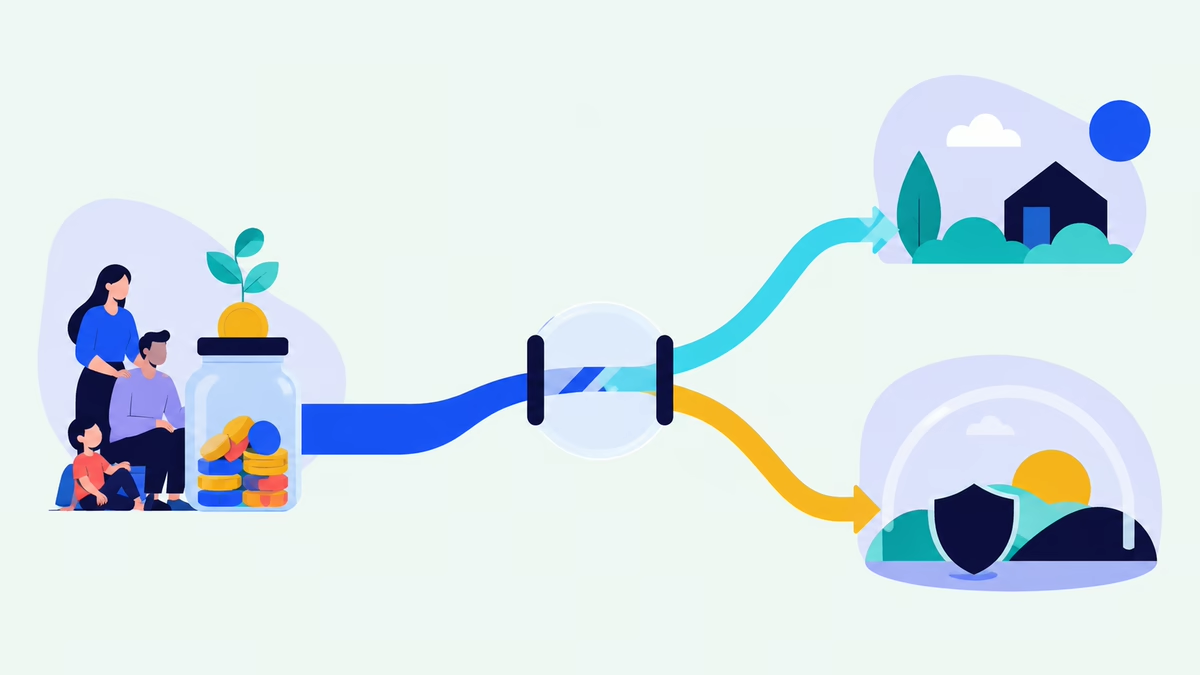
The grant is a matching payment. Contribute to the plan and the government adds $3, $2 or $1 for every dollar, depending on family income, to a maximum of $3,500 a year and $70,000 over a lifetime. The bond is different. It requires no contribution and pays up to $1,000 a year to a lifetime limit of $20,000.
| Feature | Canada Disability Savings Grant | Canada Disability Savings Bond |
|---|---|---|
| Contribution required | Yes. The grant only pays on money you put in. | No. The bond is paid whether or not anyone contributes. |
| Annual maximum | $3,500, or $10,500 when carry-forward amounts are being paid. | $1,000, or up to $11,000 when carry-forward amounts are paid at plan opening. |
| Lifetime maximum | $70,000 | $20,000 |
| What determines the amount | Family income and how much is contributed that year. | Family income only. |
| Last eligible year | December 31 of the year the beneficiary turns 49. | December 31 of the year the beneficiary turns 49. |
Both amounts land in the plan and grow tax sheltered alongside contributions. Neither counts toward the $200,000 lifetime contribution limit, and neither does the investment income they generate. A plan that receives the full bond entitlement and no private money at all still ends up with $20,000 of federal money plus whatever that sum earns.
The grant takes six to eight weeks to appear after an eligible contribution. The bond is paid each year once the application is on file, but only while the beneficiary keeps filing the required tax returns. A missing return stops the payment for that year until the filing is caught up.
Filing is the most common failure point in the whole program. The bond usually stops because Employment and Social Development Canada has no income figure for the year, not because entitlement ran out. Returns can be filed late, and the assessment is what the government reads, so a lapse is worth fixing rather than writing off.
Who can receive grants and bonds, and until what age?
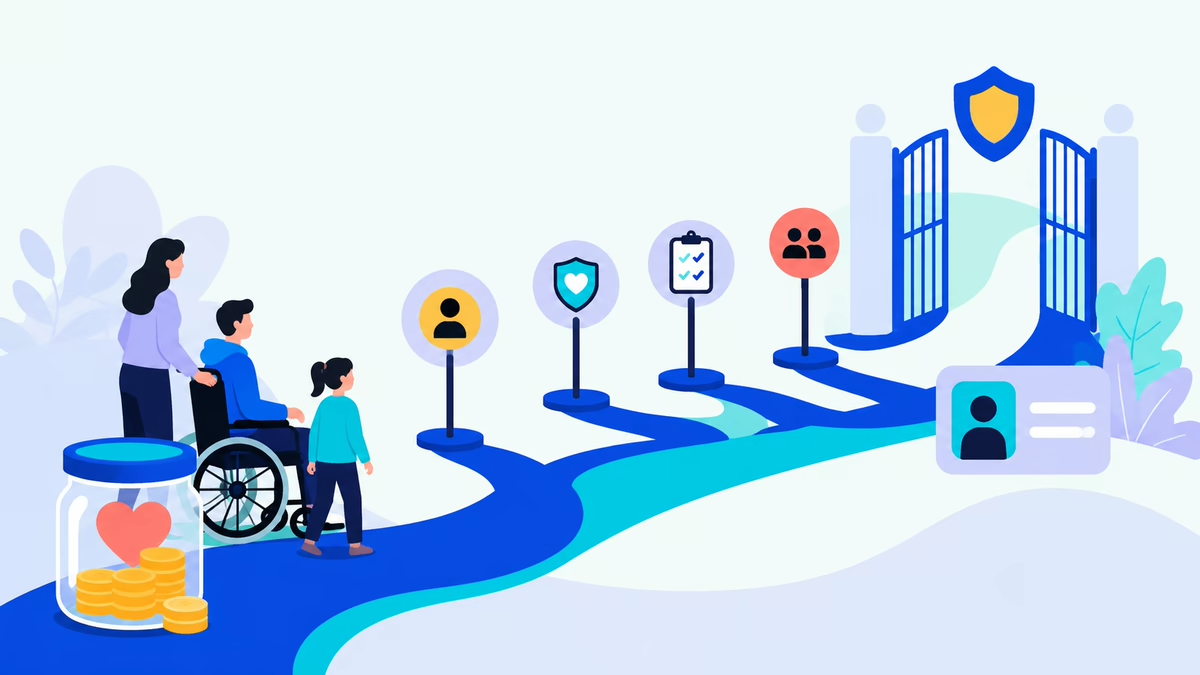
The beneficiary must be approved for the Disability Tax Credit, be a resident of Canada, and hold a valid Social Insurance Number. Grants and bonds are paid until December 31 of the year the beneficiary turns 49. A plan can still be opened until December 31 of the year they turn 59, but no federal money follows after 49.
| Age of the beneficiary | What is still available | What has closed |
|---|---|---|
| Up to the end of the year they turn 49 | Grant, bond, carry-forward amounts and contributions. | Nothing. |
| Age 50 to the end of the year they turn 59 | Contributions, tax-sheltered growth, and protection of provincial benefits. | All grant and bond payments, including carry-forward. |
| After the year they turn 59 | The existing plan and its investments. | New plans, new contributions, and rollovers. |
| By the end of the year they turn 60 | Lifetime disability assistance payments, which must begin. | The accumulation phase of the plan. |
Family income is measured differently depending on age. Until December 31 of the year the beneficiary turns 18, the combined income of the parents or guardians is used. Starting the year they turn 19, the calculation switches to the beneficiary's own income plus a spouse's or common-law partner's income if there is one.
That switch catches people. A young adult living on a modest income can move from a household that received no bond to a household income that qualifies for the full $1,000, but only if they have filed. Employment and Social Development Canada requires personal returns for at least the two previous years and every year after, starting in the year the beneficiary turns 17. No return, no payment, regardless of how low the income actually is. Our page on eligibility requirements for opening an RDSP covers the rest of the entry conditions.
How much grant does a contribution attract in 2026?
For the 2026 calendar year, family income of $117,045 or less earns $3 per dollar on the first $500 contributed and $2 per dollar on the next $1,000. A $1,500 contribution therefore produces the full $3,500. Above that income threshold, the rate drops to $1 per dollar on the first $1,000 only.
| 2026 family income | Contribution tier | Match rate | Grant produced |
|---|---|---|---|
| $117,045 or less | First $500 | $3 for every $1 | $1,500 |
| $117,045 or less | Next $1,000 | $2 for every $1 | $2,000 |
| $117,045 or less | Anything above $1,500 | No match | $0 |
| More than $117,045 | First $1,000 | $1 for every $1 | $1,000 |
| More than $117,045 | Anything above $1,000 | No match | $0 |
The bond runs on income alone. Nothing you contribute changes it, and nothing you fail to contribute takes it away.
| 2026 family income | Bond paid that year | What to do |
|---|---|---|
| $38,237 or less | $1,000, the full amount. | Apply once and keep filing tax returns every year. |
| More than $38,237 and less than $58,523 | Part of the $1,000, decreasing as income rises. | Apply anyway. A partial bond still requires no contribution. |
| $58,523 or more | No bond. | Apply anyway, since income can fall in a later year. |
There is a trap in the grant table worth naming. Contributing more than the amount that attracts a match does not earn anything extra, and Employment and Social Development Canada calls the excess an unassisted contribution. Those dollars remain part of the plan balance and may be included in a withdrawal subject to the proportional repayment rules. The repayment applies to recent grant and bond assistance, not because the private contribution was unassisted. An oversized deposit therefore needs to be considered alongside the plan's withdrawal timing. Our page on RDSP contribution limits works through the $200,000 ceiling in more detail.
Money rolled over from a registered retirement plan or an RESP is treated the same way. It counts against the $200,000 limit and attracts no matching grant at all, which is worth knowing before moving a large balance. The mechanics of that move are set out on our page about transferring funds from an RESP to an RDSP.
How does the 10-year carry-forward work?
Unused grant and bond entitlements from the previous ten years stay available. If the beneficiary was approved for the Disability Tax Credit during those years but no plan existed, or contributions were too small, the entitlement waits. Catching up on grant requires contributions. Catching up on bond does not, and happens automatically once the application is filed.
| Question | Grant | Bond |
|---|---|---|
| How far back can it reach | Ten years before the year the contribution is made. | Ten prior years plus the current year. |
| Maximum payable in one year | $10,500 | $11,000 at plan opening |
| Does it require a contribution | Yes, and the size of the contribution sets how many past years get filled. | No. |
| Which years get paid first | The oldest eligible year, at the rate that applied in that year. | Each eligible year is assessed against that year's income threshold. |
| What ends it | December 31 of the year the beneficiary turns 49. | December 31 of the year the beneficiary turns 49. |
The $10,500 annual ceiling is the reason a large single deposit rarely clears a full backlog. Someone with ten years of unused entitlement at the top matching rate is holding $15,000 of grant at the 300 percent rate and $20,000 at the 200 percent rate. At $10,500 a year, recovering all of it takes several years of contributions, and each year that passes drops the oldest year out of the window.
That is the arithmetic argument for opening a plan the moment Disability Tax Credit approval arrives, even with no money to put in it. The bond alone can be worth $11,000 in the first year for a low-income beneficiary, and it requires nothing but the application.
How do you apply for the grant and bond?
There is no separate government portal. You apply through the financial organization that issues the plan, at the same time you open it. The institution sends the application to Employment and Social Development Canada and handles the payments. The beneficiary signs the grant and bond application form, and once it is on file the bond is paid automatically each year.
| Step | Who does it | What it needs |
|---|---|---|
| Confirm Disability Tax Credit approval | The beneficiary or their representative, through the Canada Revenue Agency. | An approved Form T2201 on file. |
| Choose an issuer and open the plan | The plan holder. | Valid Social Insurance Numbers for both holder and beneficiary. |
| Sign the grant and bond application | The beneficiary, with the financial organization. | Filed tax returns for at least the two previous years. |
| Contribute if grant is the goal | Anyone, with the holder's permission. | Enough to reach the matched tiers for that year. |
| Read the annual Statement of Entitlement | The plan holder. | Nothing. It arrives every February until the year the beneficiary turns 49. |
The Statement of Entitlement is the most underused document in the whole program. It states, in dollars, how much grant is available that year including carry-forward, and how much to contribute to collect it. Anyone guessing at a contribution amount without reading it is guessing unnecessarily. Our step-by-step guide to opening an RDSP covers the paperwork side.
An adult whose ability to enter a contract is in doubt does not always need a court-appointed representative to get started. A spouse, common-law partner, parent or adult sibling can become the holder as a qualifying family member, but only where no legal representative is already in place and the financial organization, after reasonable inquiry, is not aware of anyone legally authorized to act for the beneficiary. This measure is temporary and is set to expire on December 31, 2026. The financial organization determines which route applies.
The route exists because opening a plan for an adult who cannot sign for themselves used to require a guardianship order, which can involve a court process and additional expense. A qualifying family member holder skips that step. It does not make the relative a legal representative for anything else, and it does not survive the expiry date on its own.
When do grants and bonds have to be repaid?
Withdrawing early is the main risk. For every $1 taken out, $3 of grant and bond paid in the previous ten years goes back, up to the amount still held back. Closing the plan, losing its registration, or the beneficiary's death repays the full applicable amount. Losing Disability Tax Credit approval does not by itself trigger repayment.
That ratio is the single most important number in this program and it explains why the RDSP is built for long horizons. A beneficiary who receives the maximum grant for six straight years is sitting on $21,000 of federal money that is subject to clawback. Taking out $600 in that position costs $1,800 in repaid grant, which is roughly three times what was withdrawn.
Repayment obligations shrink over time. Grant and bond paid more than ten years ago are no longer subject to clawback, and by the end of the year the beneficiary turns 60 the withdrawal phase begins in earnest. The interaction between withdrawals, repayment and income tax is covered on our page about the tax implications of RDSP withdrawals.
If you want to see what the grant and bond would be worth in a specific case rather than in the abstract, the calculator at reei.ca runs the numbers against your own income and age. It is a modelling tool, not an application, and the actual entitlement is always the amount Employment and Social Development Canada calculates.
Sources consulted
- Employment and Social Development Canada, How much you could get in grants and bonds, for the 2026 income thresholds, matching rates, annual and lifetime maximums, and carry-forward limits.
- Employment and Social Development Canada, Who can open a plan and apply, for eligibility conditions and the age 49 and age 59 deadlines.
- Employment and Social Development Canada, Make contributions and watch savings grow, for the $200,000 lifetime limit and the treatment of rollovers.
- Canada Revenue Agency, Canada disability savings grant and Canada disability savings bond, for adjusted family net income, carry-forward ceilings and the repayment rules.
- Employment and Social Development Canada, Withdraw money from your plan, for the repayment triggers and the three-to-one proportional rule.
Discover our latest articles about RDSP:



















.avif)
.avif)


