
How to open an RDSP, step by step
What do you need before you can open an RDSP?
Four conditions and a disability tax credit approval that can take time. Here is the order to open an RDSP and what the first year must cover.

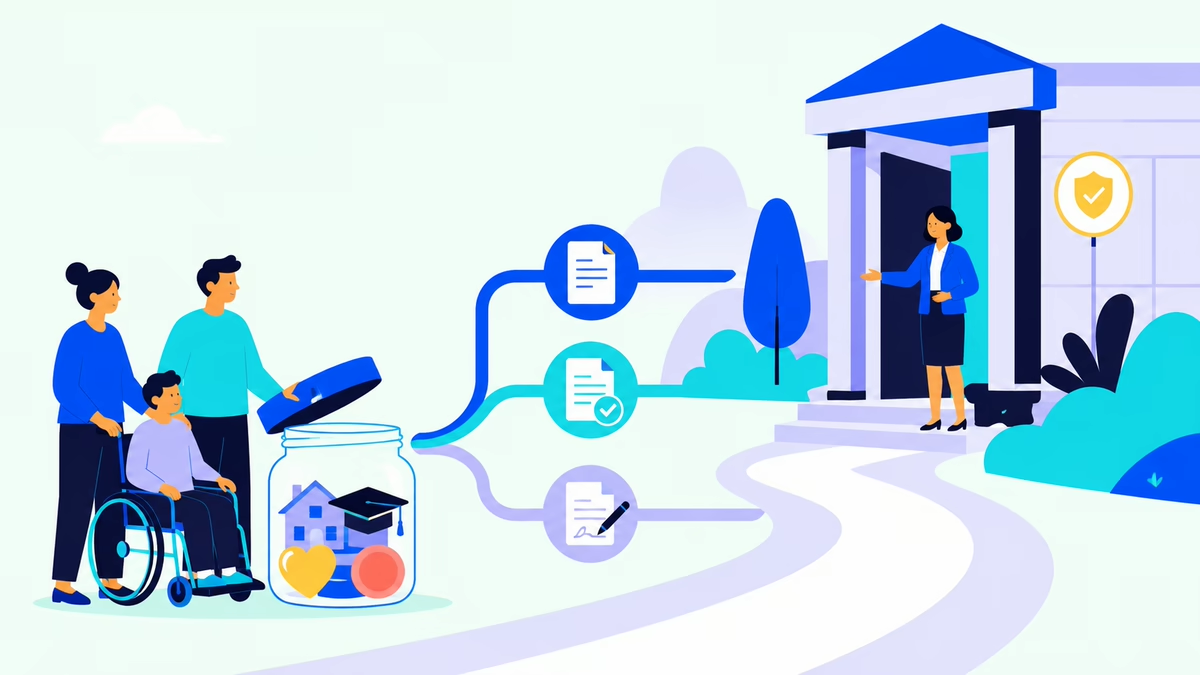
Opening an RDSP is a short administrative job sitting behind a long one. The account itself is opened with a bank, credit union or investment firm. Getting the beneficiary approved for the disability tax credit, which is the gate to everything else, is the part that can take time.
The order matters more than most guides admit. Grant and bond entitlement builds up in the background for every year the beneficiary is approved for the credit, but none of it converts into money until a plan exists to receive it. Every year that passes without opening the account is a year that will eventually fall out of the ten year carry forward window.
What do you need before you can open an RDSP?
Four conditions, and all four have to hold at once. The beneficiary must be approved for the disability tax credit, be a resident of Canada, hold a valid social insurance number, and apply before December 31 of the year they turn 59. A direct transfer from a former RDSP is the one exception.
Employment and Social Development Canada lists the four on its page on who can open a plan and apply. The Canada Revenue Agency states them again in eligibility and contributions and adds a detail that catches people: the beneficiary must be a resident of Canada both when the plan is opened and when each contribution is made. The plan holder does not have to be a resident.
One more constraint shapes everything else. A beneficiary can only have one RDSP at a time, and each plan has exactly one beneficiary. There is no way to run two plans in parallel to separate family money from a rollover.
| Condition | Who checks it | What proves it |
|---|---|---|
| Approved for the disability tax credit | Canada Revenue Agency | CRA notice of determination, or the credit visible in My Account |
| Valid social insurance number | The financial organization | SIN for the beneficiary and for an individual holder. An organization acting as holder can use its business number |
| Resident of Canada | The financial organization | Address and residency status at opening and at each contribution |
| Applying before the end of the year they turn 59 | The financial organization | Date of birth |
How do you get approved for the disability tax credit?
A medical practitioner certifies on Form T2201 that the beneficiary has a severe and prolonged impairment in physical or mental functions, and the CRA then approves or refuses the claim. Approval is not automatic on the strength of a diagnosis. The CRA assesses the functional effects described on the form.
The application runs through the CRA's disability tax credit service, which now includes a digital application. The part that decides the outcome is the practitioner's description of how the impairment affects daily functioning, and how long it has lasted or is expected to last. Diagnosis alone carries little weight.
Two consequences follow for the plan. First, approval is dated: it can cover past years, and those past approved years are exactly what generates carry forward entitlement. Second, an RDSP cannot be opened until that approval exists, so a family whose application is still in progress cannot open the plan yet, and carry forward years can expire while they wait. Our page on eligibility requirements for an RDSP covers the borderline situations.
Who can be the plan holder?
The holder is the person or organization that opens and runs the plan, and it may or may not be the beneficiary. For a minor, a parent, legal representative or public department holds the plan. An adult who can enter into a contract without a legal representative must hold their own plan.
The harder case is an adult beneficiary whose ability to enter into a contract is in doubt. A legal representative appointed under provincial or territorial law can be the holder. Where there is no legal representative, ESDC allows certain family members to open the plan instead. The qualifying family member can be the beneficiary's spouse, common law partner, parent or adult sibling. The financial organization decides which route applies.
| Situation of the beneficiary | Who can be the holder | Notes |
|---|---|---|
| Under the age of majority in their province or territory | Parent, legal representative or public department | The age of majority is 18 or 19 depending on the province or territory |
| Adult who can enter into a contract | The beneficiary | They must be the holder of their own plan |
| Adult with a legal representative | The legal representative | Includes a guardian, curator, agency, institution or public department |
| Adult with no legal representative and contract capacity in doubt | Spouse, common law partner, parent or adult sibling | The financial organization assesses which route applies |
Holders can change later. The current holder makes the request with the financial organization, which is the usual route when a beneficiary who was a minor at opening becomes an adult able to run the plan themselves.
Where can you open an RDSP?
Not every institution offers the plan. ESDC keeps a list of the banks, credit unions and investment firms that do, and you do not need an existing account with any of them to open an RDSP. Providers that are not on the list may still offer the plan, so ask directly.
The current list on the how to open a plan page includes RBC Royal Bank, BMO, Scotiabank, CIBC, TD Waterhouse, Desjardins, IG Wealth Management, Mackenzie Financial and several credit union groups. ESDC notes that the list is informational and not an endorsement. Investment options, fees and the range of eligible products differ considerably between them, and that difference compounds over a plan that may run forty years.
Two questions are worth asking before you sign. Does the organization handle the grant and bond application at the same time, and what happens to the account if the holder later needs to change. Both are ordinary requests. Neither is always handled well.
How do you open the plan and apply for grants and bonds?
The two are done together. You open the plan with the financial organization and sign the grant and bond application with it. The application is needed for carry forward bond, and carry forward grant also requires contributions. An account opened without the application collects nothing from past approved years.
ESDC is explicit on its grants and bonds page that an application for the grant and bond is needed to catch up on past years. The bond side then pays with no contribution required, up to $11,000 in the opening year, for each past year in which the beneficiary was DTC approved, resident in Canada, with returns filed and family income under the threshold. That is $1,000 for each of up to ten past eligible years plus $1,000 for the current year. The grant side requires contributions and is capped at $10,500 in a single year while catching up.
| Step | Who does it | Typical timing |
|---|---|---|
| Apply for the disability tax credit on Form T2201 | Beneficiary and a medical practitioner | Varies with the practitioner and the CRA review |
| Choose a financial organization and confirm it offers the plan | Holder | Before the appointment |
| Open the RDSP and sign the grant and bond application | Holder, with the beneficiary signing where required | Handled with the financial organization |
| Carry forward bond deposited | Government of Canada | After the application is processed, no contribution needed |
| First contribution and matching grant | Holder or any authorized contributor | Grant arrives within 6 to 8 weeks of an eligible contribution |
Signatures matter more than they look. From the year the beneficiary turns 19, the grant and bond amounts are calculated on the beneficiary's own income plus a spouse's income, and the beneficiary has to sign the grant and bond application with the financial institution as well as file personal returns. Our guide to accessing government grants and bonds sets out that paperwork.
What should you do in the first year?
Three things. File the tax returns the entitlement calculation depends on, contribute enough to collect the grant available for the year, and read the Statement of Entitlement when it arrives in February. The first two are what convert past approved years into deposits before the carry forward window moves on.
Tax returns are the piece most often missed. Until December 31 of the year the beneficiary turns 18, the calculation uses the combined income of the parents or guardians. From the year the beneficiary turns 19 it uses their own income and a spouse's, and returns must be on file for at least the two previous years. A beneficiary should start filing in the year they turn 17, even with no income at all.
The income used is always from two years earlier. Entitlement in 2026 is calculated on the 2024 return. For 2026, a family income at or below $117,045 means $1,500 collects the maximum $3,500 in grant, and a family income at or below $38,237 can mean the full $1,000 bond, provided the beneficiary is DTC approved, resident in Canada and the required returns are on file. The thresholds are indexed annually, so they shift each January.
| Task | Why it matters | Deadline |
|---|---|---|
| File the beneficiary's tax returns, and the parents' returns for a minor | Entitlement cannot be calculated without them | Returns for at least the two previous years must be on file |
| Sign the grant and bond application | Carry forward is not paid without it | At opening, or as soon after as possible |
| Contribute enough to collect the year's grant | Grant entitlement does not roll forward indefinitely | December 31 of the calendar year |
| Read the Statement of Entitlement | It gives your figure rather than the general rule | Mailed each February up to and including the year the beneficiary turns 49 |
What new holders get wrong
The most expensive error is waiting. Carry forward reaches back ten years, and each January the oldest year drops out. A family that delays after approval does not pause the clock. Entitlement from a year that falls outside the ten year window is no longer available.
The second is withdrawing early. Grants and bonds paid into the plan in the last ten years are repayable at $3 for every $1 withdrawn, up to the total paid in that period. ESDC sets it out on the withdrawals page, and the mechanics are covered further in the ten year rule for RDSP withdrawals. An RDSP is not an emergency fund.
The third is assuming everything that comes out is taxed the same way. The CRA is clear in its RDSP rules that contributions are not deductible going in and are not taxable coming out, while the grant, the bond, investment income and rollover proceeds are included in the beneficiary's income when paid. Our page on the tax implications of RDSP withdrawals works through the split.
After the account is open
Contributions are allowed until December 31 of the year the beneficiary turns 59, up to a lifetime $200,000. Grants and bonds stop much earlier, at the end of the year the beneficiary turns 49. Recurring lifetime disability assistance payments must begin by the end of the year they turn 60, subject to any CRA exception.
| Milestone | What changes | Source of the rule |
|---|---|---|
| End of the year the beneficiary turns 49 | Grants and bonds stop being payable | Employment and Social Development Canada |
| End of the year the beneficiary turns 59 | Contributions and rollovers stop being allowed | Canada Revenue Agency |
| End of the year the beneficiary turns 60 | Recurring lifetime disability assistance payments must have begun | Employment and Social Development Canada |
| Ten years after the last grant or bond payment | The repayment holdback on that money falls away | Employment and Social Development Canada |
Nothing about those dates is negotiable, and none of them depend on the financial organization. They are the reason an RDSP opened at 12 behaves very differently from one opened at 45, even with identical deposits. A plan opened late still shelters growth and still protects provincial benefit eligibility, but it collects a fraction of the government money available to a plan opened early.
Reei builds RDSP tools for Canadian families and works from those same dates when setting a contribution schedule. If you want the numbers before the appointment, our page on RDSP contribution limits covers how much to put in each year, and the plan overview covers how the account behaves once it is running.
Discover our latest articles about RDSP:




























.avif)
.avif)


